Immigrant detention is at record highs and the Trump admin wants nearly $50 billion to expand detention capacity. A new book provides critical information about who profits from detention. Read on Substack
-
-
by Andrea Castillo
Los Angeles Times
WASHINGTON — President Donald Trump says he wants to hire 10,000 new U.S. Immigration and Customs Enforcement officers and 3,000 new Border Patrol agents, but experts and the history of law enforcement hiring sprees suggest the process could be challenging, lengthy and possibly result in problematic hires.
The massive funding bill signed into law this month by Trump earmarks about $170 billion for border and immigration enforcement, including tens of billions for new deportation agents and other personnel. Department of Homeland Security Assistant Secretary Tricia McLaughlin, in a statement to The Times, said that the agency will deliver on the president’s hiring directive.
“In June, our 2025 Career Expo successfully recruited 3,000 candidates and generated 1,000 tentative job offers — nearly double the 564 from 2023,” she wrote. “Our recruitment strategy includes targeted outreach, thorough vetting and partnerships with state and local law enforcement.”
During his first term, when Trump called for ICE and U.S. Customs and Border Protection to hire 15,000 people collectively, a July 2017 report by the Homeland Security inspector general found significant setbacks.
“Although DHS has established plans and initiated actions to begin an aggressive hiring surge, in recent years the Department and its components have encountered notable difficulties related to long hire times, proper allocation of staff, and the supply of human resources,” the report states.
The independent watchdog concluded that to meet the goal of 10,000 new immigration officers, ICE would need more than 500,000 applicants. For CBP to hire 5,000 new agents, it would need 750,000 applicants.
It doesn’t appear either goal was met. In 2017, ICE hired 371 deportation officers from more than 11,000 applications and took 173 days on average to finalize hires, the news outlet Government Executive reported. And Cronkite News reported that when Trump left office in 2021, Border Patrol had shrunk by more than 1,000 agents.
“The mere mechanics of hiring that many people is challenging and takes time,” said John Pfaff, a law professor at Fordham University who studies U.S. incarceration and has researched the hiring challenges ICE faces.
When the initial version of the funding bill passed the House of Representatives, it laid out a target of at least 10,000 ICE officers, agents and support staff, specifying a minimum of 2,500 people in fiscal year 2025 and 1,875 people in each subsequent year through 2029.
The legislation didn’t outline specific hiring goals for Customs and Border Protection, the parent agency of Border Patrol, though Homeland Security said that, in addition to the 3,000 Border Patrol agents, the funding will also support the hiring of 3,000 more customs officers at ports of entry.
The Senate modified the bill and on final passage, the law removed those hiring specifics, meaning ICE can use the funding for a variety of purposes. ICE has more than 20,000 law enforcement and support personnel. CBP has 60,000 employees, including about 19,000 Border Patrol agents.
Studies on accelerated hiring efforts have found that, in some cases, contracts were poorly managed. Ten months into a 2018 contract with the professional services firm Accenture, by which point CBP had paid $13.6 million, the inspector general found that just two people had accepted job offers.
Hiring thousands of employees would be an even bigger lift today, Pfaff said.
He pointed to the fact that since 2020, police departments nationwide have also struggled to recruit and retain officers. Immigration officer pay is lower than rookie salaries at big-city law enforcement agencies, such as the New York Police Department.
A job posting for a deportation officer offers a salary range of about $50,000 to $90,000. Pfaff compared that with NYPD, where officer salaries start at just over $60,000 and rise to more than $125,000 in less than six years.
Another recruitment push resulted in a wave of high-profile corruption cases.
During a Border Patrol hiring spree from 2006 to 2009, standards for hiring and training were lowered, about 8,000 agents were brought on. The Associated Press reported that the number of employees arrested for misconduct — such as civil rights violations or off-duty crimes like domestic violence — grew yearly between 2007 and 2012, reaching 336, or a 44% increase. More than 100 employees were arrested or charged with corruption, including taking bribes to smuggle drugs or people.
A 2015 report from an internal audit by a CBP advisory council said that “arrests for corruption of CBP personnel far exceed, on a per capita basis, such arrests at other federal law enforcement agencies.”
Josiah Heyman, an anthropology professor who directs the University of Texas at El Paso’s Center of Inter-American and Border Studies, studied the mid-2000s hiring spree. He said smuggling organizations have only gotten more sophisticated since then, as have security measures, so it’s more valuable for smugglers to “buy someone off” instead of attempting to bring in people or drugs undetected.
Beyond corruption, Heyman said he worries the drive to quickly increase Homeland Security staffing could lead to Americans being deported, as well as an increase of assault and abuse cases and deaths of detainees.
“Getting 10,000 [new employees] means basically hiring the people who walk in the door because you’re trying to hit your quota,” he said. “Rapid, mass-hiring lends itself to mistakes and cutting corners.”
The recruitment issues at Border Patrol led to reforms, such as the Anti-Border Corruption Act of 2010, which included mandatory polygraph testing for job applicants (though that requirement was not implemented for ICE applicants). The polygraph tests revealed some applicants had concerning backgrounds, including some believed to have links to organized crime.
The reforms also slowed hiring as two-thirds of Border Patrol applicants began failing the polygraph exam by 2017, the Associated Press reported.
If the government is not able to hit its hiring goals, it might turn to contractors, the U.S. military and local law enforcement to help carry out Trump’s aggressive crackdown on immigration. It is likely to continue its expansion of the 287(g) program, which deputizes local law enforcement to function as deportation agents. Homeland Security said the new budget will fully fund the 287(g) program.
Pfaff said that while using local police to make immigration arrests could help in the short term, many major cities and states, including California, have already banned the agreements or limited cooperation with ICE. Still, ProPublica reported that more than 500 law enforcement agencies have signed 287(g) agreements since January.
Jason Houser, who was ICE’s chief of staff under the Biden administration, said training new hires takes about a year and that classes are typically capped at 50 students.
Houser said another short-term workaround for permanent staff could be the use of contractors.
Most immigrant detainees are held in facilities that are run by private prison companies, including the Florida-based GEO Group and Tennessee-based CoreCivic.
But those companies have a limited inventory of detention space. CBP could also use its funding to erect soft-sided, temporary facilities on military bases within the 100 miles of the U.S. boundary, in which CBP has authority to conduct immigration checkpoints and other enhanced enforcement activities.
Houser said temporary facilities could be set up by October, and they could be staffed with National Guard or U.S. military personnel in administrative, nursing, food and sanitation roles.
Federal law generally prohibits the military from arresting civilians. But Homeland Security officials have said military personnel have the authority to temporarily detain anyone who attacks an immigration agent until law enforcement can arrest them.
But Houser worries that placing young service members, who aren’t trained to conduct civil detention, in charge of those facilities will lead to people getting hurt. He also worries that without other countries agreeing to accept more deportees, the number of immigrants detained for months could quickly balloon.
As of June 29, there were nearly 58,000 immigrants held in detention, according to TRAC, a nonpartisan data research organization. That’s far beyond the congressionally approved 41,500 detention beds this fiscal year.
“This is 9/11-style money,” Houser said. “Think about the money in counterterrorism post-9/11. It turns the entire apparatus toward this goal. Everything in government is going to turn to where the money is, and that’s the scary piece to me.”
-
-
Weekly roundup for July 20, 2025 by G. Elliott Morris
This week in political data: Epstein and Trump, NPR, and the missing 2020 Biden voters. + for the first time in his second term, Trump has a lower approval rating on deportations than on the economy. Read on Substack
-
By Alejandro Serrano, The Texas Tribune
July 17, 2025
“Texas judge dismisses case against migrant deported to El Salvador for being an alleged gang member” was first published by The Texas Tribune, a nonprofit, nonpartisan media organization that informs Texans — and engages with them — about public policy, politics, government and statewide issues.
Sign up for The Brief, The Texas Tribune’s daily newsletter that keeps readers up to speed on the most essential Texas news.
A Texas judge this week dismissed a misdemeanor trespassing case against a man who was arrested by state troopers upon crossing the U.S.-Mexico border and accused of being a Venezuelan gang member — a designation that led federal authorities to send him to a notorious prison in El Salvador, court records show.
Despite the dismissal, it appears Pedro Luis Salazar-Cuervo, a 28-year-old from Venezuela with no known criminal record, remains in the maximum security prison known as the Terrorism Confinement Center, or CECOT.
The Department of Public Safety arrested Salazar-Cuervo on New Year’s Eve when he crossed the Rio Grande from Mexico into Maverick County. State police accused him of being a member of the Tren de Aragua gang — which President Donald Trump has designated a terrorist organization — because they found a photo of him on a phone posing with another man with tattoos who was also accused of being a gang member, his lawyers wrote in earlier court filings.
Salazar-Cuervo does not have any tattoos, according to court documents as well as his jail booking documents.
A U.S. Department of Homeland Security spokesperson insisted in a statement Thursday that Salazar-Cuervo is a gang member, but declined to share evidence.
Within three months of his arrest, Salazar-Cuervo was sent to the Terrorism Confinement Center along with more than 230 others who Trump called “the worst of the worst” — even as the administration knew most of the individuals had no U.S. convictions.
Last month District Judge Maribel Flores ordered Maverick County prosecutors to ask the federal government to return Salazar-Cuervo to Texas to face trial in August. DPS has arrested thousands of people on criminal trespassing charges since Gov. Greg Abbott launched a massive border crackdown in 2021 that surged troopers and National Guard soldiers to communities along the 1,250 miles of border Texas shares with Mexico.
But on Tuesday, a Maverick County judge dismissed the case following a motion to do so from a county prosecutor “in the interest of justice,” according to the order and motion. The prosecutor, Luis Gurrola-Villarreal, did not elaborate further in the motion and did not return a request for comment Thursday.
Rick Treviño, an attorney with the Lone Star Defenders Office who is representing Salazar-Cuervo in the case, said the state’s move to dismiss the charge “highlights the frivolousness of their claim that he is a member of a gang.”
“Pedro’s deportation to an El Salvador prison without due process, a fundamental aspect of our justice system, shocks the conscience,” Treviño said. “The truth is Pedro isn’t a gang member. He is a father, a brother, a son — with no criminal history. We hope that he is brought back to the United States soon.”
A DPS spokesperson did not immediately return a request for comment.
ICE arrested Salazar-Cuervo seven days after he entered the country, DHS spokesperson Tricia McLaughlin said Thursday. An immigration judge issued a final order of removal in early March.
“We are confident in our law enforcement’s intelligence, and we aren’t going to share intelligence reports and undermine national security every time a gang member denies he is one. That would be insane,” McLaughlin said. “DHS intelligence assessments go well beyond just gang affiliate tattoos and social media.”
Salazar-Cuervo’s case was among the latest examples of Texas police accusing someone of being a member of Tren de Aragua based on thin or questionable evidence. In Hays County, DPS led a raid of what authorities claimed to be a party of suspected gang members or affiliates — and arrested nearly 50 people, including children, who the federal government is moving to deport. The authorities involved in the raid have not presented evidence to back up their claim.
The Trump administration has leveled the accusation based on “gang identifiers” like Chicago Bulls jerseys and tattoos of clocks, stars and crowns — even as Latin American criminologists have widely and repeatedly debunked the connection between tattoos and Tren de Aragua membership.
Salazar-Cuervo grew up in a tiny Venezuelan town where Tren de Aragua does not operate, his sister said in court documents.
The lineup for The Texas Tribune Festival continues to grow! Be there when all-star leaders, innovators and newsmakers take the stage in downtown Austin, Nov. 13–15. The newest additions include comedian, actor and writer John Mulaney; Dallas mayor Eric Johnson; U.S. Sen. Amy Klobuchar, D-Minnesota; New York Media Editor-at-Large Kara Swisher; and U.S. Rep. Veronica Escobar, D-El Paso. Get your tickets today!
TribFest 2025 is presented by JPMorganChase.
This article originally appeared in The Texas Tribune at https://www.texastribune.org/2025/07/17/texas-migrant-el-salvador-tren-de-aragua-deportation-dismissed/.
The Texas Tribune is a member-supported, nonpartisan newsroom informing and engaging Texans on state politics and policy. Learn more at texastribune.org.
-
A recent Gallup poll (June 2-26, 2025) of 1402 US adults shows opinions about
immigrants/immigration policy has significantly changed since the 2024 election –
during which opinions surged in favor of deportations possibly because of the high
numbers of asylum-seekers who were being admitted into the US (legally) but
who were publicly labelled “Illegal aliens” by the primary Republican candidate
and, erroneously, much of the media.
Please share
KEY TAKE-AWAYS:
79% say immigration is good for the country (up from 64% in 2024)
78% support allowing undocumented immigrants to become US citizens
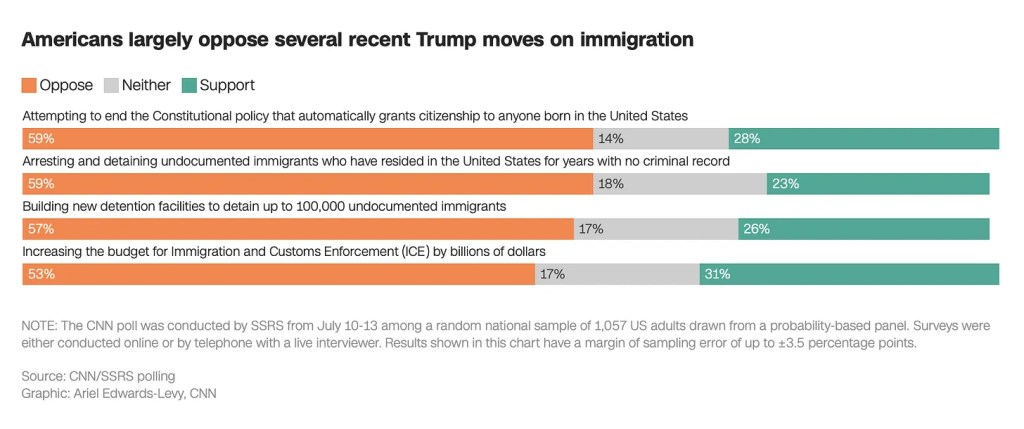
62% disapprove of Trump’s handling of immigration
35% approve/strongly approve of Trump’s handling of immigration
26% say immigration should be increased
38% say keep immigration at current levels
30% say immigration should be reduced (down from 55%, 2024)
45% back the expansion of the US/MX border wall (down from 53%, 2024)
59% support increasing number of Border Patrol (down from 76%, 2024)
-

The IRS Is Building a Vast System to Share Millions of Taxpayers’ Data With ICE
by William Turton, Christopher Bing and Avi Asher-Schapiro
ProPublica is a Pulitzer Prize-winning investigative newsroom. Sign up for The Big Story newsletter to receive stories like this one in your inbox.
The Internal Revenue Service is building a computer program that would give deportation officers unprecedented access to confidential tax data.
ProPublica has obtained a blueprint of the system, which would create an “on demand” process allowing Immigration and Customs Enforcement to obtain the home addresses of people it’s seeking to deport.
Last month, in a previously undisclosed dispute, the acting general counsel at the IRS, Andrew De Mello, refused to turn over the addresses of 7.3 million taxpayers sought by ICE. In an email obtained by ProPublica, De Mello said he had identified multiple legal “deficiencies” in the agency’s request.
Two days later, on June 27, De Mello was forced out of his job, people familiar with the dispute said. The addresses have not yet been released to ICE. De Mello did not respond to requests for comment, and the administration did not address questions sent by ProPublica about his departure.
The Department of Government Efficiency began pushing the IRS to provide taxpayer data to immigration agents soon after President Donald Trump took office. The tax agency’s acting general counsel refused and was replaced by De Mello, who Trump administration officials viewed as more willing to carry out the president’s agenda. Soon after, the Department of Homeland Security, ICE’s parent agency, and the IRS negotiated a “memorandum of understanding” that included specific legal guardrails to safeguard taxpayers’ private information.
In his email, De Mello said ICE’s request for millions of records did not meet those requirements, which include having a written assurance that each taxpayer whose address is being sought was under active criminal investigation.
“There’s just no way ICE has 7 million real criminal investigations, that’s a fantasy,” said a former senior IRS official who had been advising the agency on this issue. The demands from the DHS were “unprecedented,” the official added, saying the agency was pressing the IRS to do what amounted to “a big data dump.”
In the past, when law enforcement sought IRS data to support its investigations, agencies would give the IRS the full legal name of the target, an address on file and an explanation of why the information was relevant to a criminal inquiry. Such requests rarely involved more than a dozen people at a time, former IRS officials said.
Danny Werfel, IRS commissioner during the Biden administration, said the privacy laws allowing federal investigators to obtain taxpayer data have never “been read to open the door to the sharing of thousands, tens of thousands, or hundreds of thousands of tax records for a broad-based enforcement initiative.”
A spokesperson for the White House said the planned use of IRS data was legal and a means of fulfilling Trump’s campaign pledge to carry out mass deportations of “illegal criminal aliens.”
Taxpayer data is among the most confidential in the federal government and is protected by strict privacy laws, which have historically limited its transfer to law enforcement and other government agencies. Unauthorized disclosure of taxpayer return information is a felony that can carry a penalty of up to five years in prison.
The system that the IRS is now creating would give ICE automated access to home addresses en masse, limiting the ability of IRS officials to consider the legality of transfers. IRS insiders who reviewed a copy of the blueprint said it could result in immigration agents raiding wrong or outdated addresses.
“If this program is implemented in its current form, it’s extremely likely that incorrect addresses will be given to DHS and individuals will be wrongly targeted,” said an IRS engineer who examined the blueprints and who, like other officials, spoke on condition of anonymity for fear of retribution.
The dispute that ended in De Mello’s ouster was the culmination of months of pressure on the IRS to turn over massive amounts of data in ways that would redefine the relationship between the agency and law enforcement and reduce taxpayers’ privacy, records and interviews show.
In one meeting in late March between senior IRS and DHS officials, a top ICE official made a suggestion: Why doesn’t Homeland Security simply provide the name and state of its targets and have the IRS return the addresses of everyone who matches that criteria?
The IRS lawyers were stunned. They feared they could face criminal liability if they handed over the addresses of individuals who were not under a criminal investigation. The conversation and news of deeper collaboration with ICE so disturbed career staff that it led to a series of departures in late March and early April across the IRS’ legal, IT and privacy offices.
They were “pushing the boundaries of the law,” one official said. “Everyone at IRS felt the same way.”
The Blueprint
The technical blueprint obtained by ProPublica shows that engineers at the agency are preparing to give DHS what it wants: a system that enables massive automated data sharing. The goal is to launch the new system before the end of July, two people familiar with the matter said.
The DHS effort to obtain IRS data comes as top immigration enforcement leaders face escalating White House pressure to deport some 3,000 people per day, according to reports.
One federal agent tasked with assisting ICE on deportations said recent operations have been hamstrung by outdated addresses. Better information could dramatically speed up arrests. “Some of the leads that they were giving us were old,” said the agent, who spoke on condition of anonymity because he was not authorized to speak with the press. “They’re like from two administrations ago.”
In early March, immigrants rights groups sued the IRS hoping to block the plan, arguing that the memorandum of understanding between DHS and the IRS is illegal. But a judge in early May ruled against them, saying the broader agreement complied with Section 6103, the existing law regulating IRS data sharing. That opened the door for engineers to begin building the system.
The judge did not address the technical blueprint, which didn’t exist at the time of the ruling. But the case is pending, which means the new system could still come under legal review.
Until now, little was known about the push and pull between the two agencies or the exact technical mechanics behind the arrangement.
The plan has been shrouded in secrecy even within the IRS, with details of its development withheld from regular communications. Several IRS engineers and lawyers have avoided working on the project out of concerns about personal legal risk.
Asked about the new system, a spokesperson for IRS parent agency the Treasury Department said the memorandum of understanding, often called an MOU, “has been litigated and determined to be a lawful application of Section 6103, which provides for information sharing by the IRS in precise circumstances associated with law enforcement requests.”
At a time when Trump is making threats to deport not only undocumented immigrants but also U.S. citizens, the scope of information-sharing with the IRS could continue to grow, according to documents reviewed by ProPublica and sources familiar with the matter: DHS has been looking for ways to expand the agreement that could allow Homeland Security officials to seek IRS data on Americans being investigated for various crimes.
Last month, an ICE attorney proposed updating the MOU to authorize new data requests on people “associated with criminal activities which may include United States citizens or lawful permanent residents,” according to a document seen by ProPublica. The status of this proposal is unclear. De Mello, at the time, rejected it and called for senior Treasury Department leadership to personally sign off on such a significant change.
The White House described DHS’ work with the IRS as a good-faith effort to identify and deport those who are living in the country illegally.
“ProPublica continues to degrade their already terrible reputation by suggesting we should turn a blind eye to criminal illegal aliens present in the United States for the sake of trying to collect tax payments from them,” White House spokesperson Abigail Jackson said in a statement after receiving questions about the blueprint from ProPublica.
She pointed to the April MOU as giving the government the authority to create the new system and added, “This isn’t a surveillance system. … It’s part of President Trump’s promise to carry out the mass deportation of criminal illegal aliens — the promise that the American people elected him on and he is committed to fulfilling.”
In a separate statement, a senior DHS official also cited the court’s approval of the MOU, saying that it “outlines a process to ensure that sensitive taxpayer information is protected while allowing law enforcement to effectively pursue criminal violations.”
How the System Works
The new system would represent a sea change, allowing law enforcement to request enormous swaths of confidential data in bulk through an automated, computerized process.
The system, according to the blueprint and interviews with IRS engineers, would work like this:
First, DHS would send the IRS a spreadsheet containing the names and previous addresses of the people it’s targeting. The request would include the date of a final removal order, a relevant criminal statute ICE is using to investigate the individual, and the tax period for which information is sought. If DHS fails to include any of this information, the system would reject the request.
The system then attempts to match the information provided by the DHS to a specific taxpayer identification number, which is the primary method by which the IRS identifies an individual in its databases.
If the system makes a match, it accesses the individual’s associated tax file and pulls the address listed during the most recent tax period. Then the system would produce a new spreadsheet enriched with taxpayer data that contains DHS’ targets’ last known addresses. The spreadsheet would include a record of names rejected for lack of required information and names for which it could not make a match.
Tax and privacy experts say they worry about how such a powerful yet crude platform could make dangerous mistakes. Because the search starts with a name instead of a taxpayer identification number, it risks returning the address of an innocent person with the same name as or a similar address to that of one of ICE’s targets. The proposed system assumes the data provided by DHS is accurate and that each targeted individual is the subject of a valid criminal investigation. In effect, the IRS has no way to independently check the bases of these requests, experts told ProPublica.
In addition, the blueprint does not limit the amount of data that can be transferred or how often DHS can request it. The system could easily be expanded to acquire all the information the IRS holds on taxpayers, said technical experts and IRS engineers who reviewed the documents. By shifting a single parameter, the program could return more information than just a target’s address, said an engineer familiar with the plan, including employer and familial relationships.
Engineers based at IRS offices in Lanham, Maryland, and Dallas are developing the blueprint.
“Gone Back on Its Word”
For decades, the American government has encouraged everyone who makes an income in the U.S. to pay taxes — regardless of immigration status — with an implicit promise that their information would be protected. Now that same data may be used to locate and deport noncitizens.
“For years, the IRS has told immigrants that it only cares that they pay their taxes,” said Nandan Joshi, an attorney with the Public Citizen Litigation Group, which is seeking to block the data-sharing agreement in federal court. “By agreeing to share taxpayer data with ICE on a mass basis, the IRS has gone back on its word.”
The push to share IRS data with DHS emerged while Elon Musk’s DOGE reshaped the engineering staff of the IRS. Sam Corcos, a Silicon Valley startup founder with no government experience, pushed out more than 50 IRS engineers and restructured the agency’s engineering priorities while he was the senior DOGE official at the agency. He later became chief information officer at Treasury. He has also led a separate IRS effort to create a master database using products from Silicon Valley giant Palantir Technologies, enabling the government to link and search large swaths of data.
Corcos didn’t respond to a request for comment. The White House said DOGE is not part of the DHS-IRS pact.
Sen. Ron Wyden, the ranking Democrat on the Senate Committee on Finance, which oversees the IRS, told ProPublica the system being built was ripe for abuse. It “would allow an outside agency unprecedented access to IRS records for reasons that have nothing to do with tax administration, opening the door to endless fishing expeditions,” he said.
The Treasury Inspector General for Tax Administration, the department’s internal watchdog, is already probing efforts by Trump and DOGEto obtain private taxpayer data and other sensitive information, ProPublica reported in April.
The Trump administration continues to add government agencies to its deportation drive.
DOGE and DHS are also working to build a national citizenship database, NPR reported last month. The database links information from the Social Security Administration and the DHS, ostensibly for the purpose of allowing state and local election officials to verify U.S. citizenship.
And in May, a senior Treasury Department official directed 250 IRS criminal investigative agents to help deportation operations, a significant shift for two agencies that historically have had separate missions.
McKenzie Funk contributed reporting, and Kirsten Berg and Alex Mierjeski contributed research.
-
July 14, 2025 by Heather Cox Richardson
Read on Substack -
-
 Immigration Insight