This overview of various surveillance and data collection technologies (provided by Just Futures Law) covers biometric data, social media review, hacking cellphones and car data being contracted for and/or used at or near the US/Mx border and explains how various companies are involved with contracts with the federal government.
-
Third-country deportees have already been sent to South Sudan and Eswatini and Rwanda may take up to 250 deportees from third-countries who refuse to take them back.

Matsapha Correctional Facility in Eswatini
-
The new report explains how the Trump administration is using a longstanding loophole to circumvent sanctuary policies and obscure the full scale of its immigration actions.
July 30, 2025
This morning, the Prison Policy Initiative released Hiding in Plain Sight, a report revealing the crucial role that locally-run jails are playing in President Trump’s program of mass deportation — and why states and counties must do more to end cooperation. Building on the organization’s work explaining how county jails enable state and federal incarceration, this report breaks down the complicated overlap between local criminal justice and immigration, and offers detailed data tables showing the level of involvement in every state and in specific jails.
Key findings include:

- The Trump administration is circumventing city and county sanctuary policies that limit cooperation with federal immigration authorities. It accomplishes this through a longstanding loophole: ICE and other federal agencies can refer people for federal prosecution on immigration-related “crimes” and thus use local jails’ contracts with the U.S. Marshals Service in sanctuary cities, counties, and states. In doing so, the Trump administration is transforming what are normally civil immigration matters into more serious federal crimes.
- ICE data doesn’t show the full scale of immigrant detention in the U.S. While ICE detention data recorded 57,200 people on average in June 2025, the true count of people detained shows the overall crimmigration system is 45% larger, at around 83,400 people. That’s because ICE data does not account for people facing criminal immigration charges (as explained above), nor does it account for people held on ICE detainers, in some state detention facilities, or in overnight hold rooms.
- Jails and police departments play a key role in criminalizing immigration by detaining people until ICE agents can make an arrest. ICE has capitalized on local detention of immigrants — often on minor charges or charges that would not lead to jail time for U.S. citizens (such as driving without a license) — to not only make more arrests, but to enhance the appearance of targeting “criminals.” Arrests in jails comprise 45% of ICE arrests since Trump’s inauguration in January.
“Many cities and states have tried to offer sanctuary for immigrants by refusing to rent jail space to ICE and opting out of the 287(g) program, but it is not enough,” said report author Jacob Kang-Brown. “The Trump administration is leveraging jails at a new scale, using local contracts with the U.S. Marshals Service and existing policing practices in order to expand detention.”
For reporters who want to dig deeper into these trends in their own counties and states, the report includes data tables showing:
- How many people are being held for ICE and the U.S. Marshals in over 600 local jails (and over 150 other facilities), the change in these populations from January to April 2025, and the share of all detained immigrants in every state being held by jails.
- The rate of ICE arrests happening in jails, compared to other locations, in every state.
- The number of immigrants arrested by the U.S. Marshals on various charge types over time — showing that a quickly-growing share of these people are being booked on charges related to their immigration status.
- The per-diem payments by the U.S. Marshals to hundreds of local jails in exchange for housing immigrants and other federal pretrial detainees.
The report concludes by urging counties to end all of their collaborations with federal immigration detention agencies, including the U.S. Marshals Service, which has contracts with nearly 1,000 jails nationwide. Via their jails, local governments are — intentionally or not — providing the infrastructure for a massive attack on immigrants. But by resisting cooperation with President Trump’s racist deportation machine, counties and states also have the power to contain it.
The full report is available at: https://www.prisonpolicy.org/reports/jails_immigration.html
-
WASHINGTON – Today, the Justice Department published a list of states, cities, and counties identified as having policies, laws, or regulations that impede enforcement of federal immigration laws.
“Sanctuary policies impede law enforcement and put American citizens at risk by design,” said Attorney General Pamela Bondi. “The Department of Justice will continue bringing litigation against sanctuary jurisdictions and work closely with the Department of Homeland Security to eradicate these harmful policies around the country.”
On April 28, 2025, President Trump signed Executive Order 14287: Protecting American Communities from Criminal Aliens. The Executive Order recognized that “some State and local officials . . . continue to use their authority to violate, obstruct, and defy the enforcement of Federal immigration laws” and “[i]t is imperative that the Federal Government restore the enforcement of United States law.” The Executive Order directed the Justice Department, in collaboration with the Department of Homeland Security, to publish a list of such jurisdictions. Accordingly, the following states, cities, and counties have been identified as sanctuary jurisdictions:
STATES:
- California
- Colorado
- Connecticut
- Delaware
- District of Columbia
- Illinois
- Minnesota
- Nevada
- New York
- Oregon
- Rhode Island
- Vermont
- Washington
COUNTIES:
- Baltimore County, MD
- Cook County, IL
- San Diego County, CA
- San Francisco County, CA
CITIES:
- Albuquerque, NM
- Berkeley, CA
- Boston, MA
- Chicago, IL
- Denver, CO
- East Lansing, MI
- Hoboken, NJ
- Jersey City, NJ
- Los Angeles, CA
- New Orleans, LA
- New York City, NY
- Newark, NJ
- Paterson, NJ
- Philadelphia, PA
- Portland, OR
- Rochester, NY
- Seattle, WA
- San Francisco City, CA
In recent months, the Justice Department has filed several lawsuits against sanctuary jurisdictions seeking to compel compliance with federal law, including one against New York City on July 24th. Recently, the Mayor of Louisville agreed to revoke their sanctuary policies following a letter from the Justice Department threatening legal action.
Read more about the sanctuary jurisdiction list and the criteria for inclusion here. This list is not exhaustive and will be updated as federal authorities gather further information. The federal government will assist any jurisdiction that desires to be taken off this list to identify and eliminate their sanctuary policies, so they no longer stand in opposition to federal immigration enforcement.
-
DACA (Deferred Access for Childhood Arrivals) protects 500,000+ people from over 100 countries of origin. There is some confusion about whether people with this status can be deported or not.
Read on NPR Here: https://www.npr.org/2025/07/29/nx-s1-5482923/dhs-daca-recipients-self-deport

-
-
Based on a law that was passed by Congress in 2005 and revised procedurally in 2020, the federal government (CBP and ICE) is now collecting DNA samples from non-citizen and, as of April 2025, over 2.6 million samples have been collected.
From each sample, the FBI creates a profile and enters it into CODIS – a criminal database.
Stevie Glaberson, from the Georgetown Law Center on Privacy and Technology, says this may violate the 4th Amendment – not only the search and seizure of taking the DNA sample as a speculative matter (in anticipation of a potential crime).
Here’s the 44-minute video about this issue.
-
The federal government is raising immigration-related fees over the course of the next few months. These new fees are summarized in this National Immigrant Justice Center explainer and include fees for changes of status applications, work permit applications, court fees, annual fees. There is a handy chart at the bottom of the explainer which summarizes the details.
-
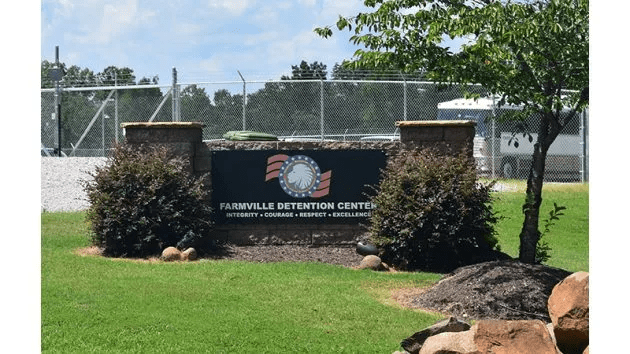
June 10, 2025
The Farmville Detention Center has new ownership. That filing came Tuesday night, announcing that CoreCivic, based out of Brentwood, Tennessee, had acquired the Farmville facility for a total price of $67 million. The deal is expected to close as of July 1, with 100% of the membership interest transferring to CoreCivic from Abyon LLC, the previous owners. According to the U.S. Securities and Exchange Commission, CoreCivic is the second largest private corrections company in the nation, managing more than 65 state and federal detention facilities. They have properties in 19 states and the District of Columbia. Now that portfolio includes the Farmville facility, a 736-bed facility located at 508 Waterworks Road. According to CoreCivic’s Public Affairs Director Ryan Gustin, some things will stay the same and some will change, with improvements already planned out. Gustin said that the current administrator at the Detention Center, Jeff Crawford, will remain in that role. The company also plans to add to the current number of employees, with “specialty and supervisory positions that will enhance facility operations and create more promotion and career advancement opportunities for staff,” Gustin said.
Gustin added that staff members at the center will also get some enhanced benefits as part of the sale. That includes medical, dental and vision insurance, a matching 401(k), paid leave, health advocacy services, financial wellness services, an employee assistance program and a tuition assistance scholarship fund. He added that the company has been reaching out to staff members this week, looking to answer any questions they might have about the shift. A change in the CUP The sale announcement also clears up why Abyon had a sudden need over the last month to clear up the town’s conditional use permit. As reported last week, the Farmville town council agreed to amend the facility’s conditional use permit to match what was agreed to, but never amended, back in 2011. Up to 2011, the facility was only able to house Level 1 detainees under the permit. That was requested by the company and agreed to be changed to “any adult immigrant detainees”. That zoning change was approved by the council in 2011. However, while the zoning ordinance was changed, the conditional use permit wasn’t. That error was corrected earlier this month.As for the detention center, Gustin also said there would be some improvements to the facility, moving forward. He said CoreCivic plans to invest $5.4 million to upgrade the security systems and perimeter fencing, as well as replacing skylights and improving airflow in the facility. Clearing up a few things Now before we move forward, there’s a couple things to make clear. First off, no, neither Prince Edward County or Farmville get part of that sale price. That’s because neither entity owns or operates any part of the facility. As we mentioned last week, Farmville now is just the host town for the facility. The center has to follow town ordinances, but that’s where the connection ends. To explain, the Farmville council in March 2024 agreed to end their contract with ICE. Prince Edward County took over the contract as the local government connection. That contract remains in place, despite the sale. Gustin confirmed that to The Herald this week. Nothing changes in that document other than the name of the building owner.
The current contract between the county and the detention center runs through March 29, 2029. At that point, the county will have the option to renew, renegotiate or terminate the contract. Prince Edward officials say they’ve spoken with CoreCivic about the sale. “I am pleased that they are committed to ensuring the continuity of the Farmville Detention Center’s operations and enhancing benefits for staff, many of whom call Prince Edward County home,” said Prince Edward County Administrator Doug Stanley. “I also appreciate their commitment to investing in facility upgrades to make it safer, more secure and to provide a better work environment. They also have pledged to continue to be a good corporate partner for Prince Edward and the surrounding communities.” Being a more visible partner There’s one thing Gustin said the company wants to do more than its predecessor and that’s to be visible in the community. By that, he points to a planned $25,000 in charitable giving the group is looking to do. The first of those announcements will be made in the coming weeks, he said. The company expects to pay more than $180,000 in annual real estate and property taxes, as well as annual fees through the current contract with Prince Edward, expected to be roughly $750,000. Concerns for the Farmville Detention Center On the other hand, both the company and county said they’re aware of concerns about the Farmville Detention Center, everything from the escapes earlier this year to the death of a detainee and closure of the center during the pandemic. CoreCivic has also faced controversies in the past at some of its properties. In 2021, the company agreed to pay $56 million to settle a lawsuit accusing the company of inflating stock prices and claiming it “ran unsafe, low quality prisons that caused multiple deaths.” Those claims were never verified. In 2018, the Southern Poverty Law Center (SPLC) filed a class-action lawsuit on behalf of three former detainees against CoreCivic for the practices at the Stewart Detention Center in Lumpkin, Georgia. They claimed that the facility used forced labor to maintain their facility in order to maximize profits. The groups came to a settlement in 2023. Again, like the lawsuit before it, the claims mentioned here were not proven in court. County officials acknowledged the concerns, regardless. “We recognize the concerns about corporate entities operating detention centers,” Stanley said. “That is why the County is committed to advocating for the highest standards of care, oversight, and accountability — no matter who owns the facility.” Stanley pointed to the part of the contract that says he can go into the facility at any point, 24 hours a day. Other county officials are also allowed access. Gustin meanwhile pointed to the fact the Farmville Detention Center will have to follow federal safety and health guidelines. He added that the detention center will “operate with strong oversight and accountability from our government partners, including regular audits and onsite monitors. Both CoreCivic and our government partners share a deep commitment to humane care.”
-

